Useful
phrases
The following phrases will make your
letter look good. In case it is hard for you to remember all of them, choose just one for each paragraph, memorize it and use for all
the letters of this type.
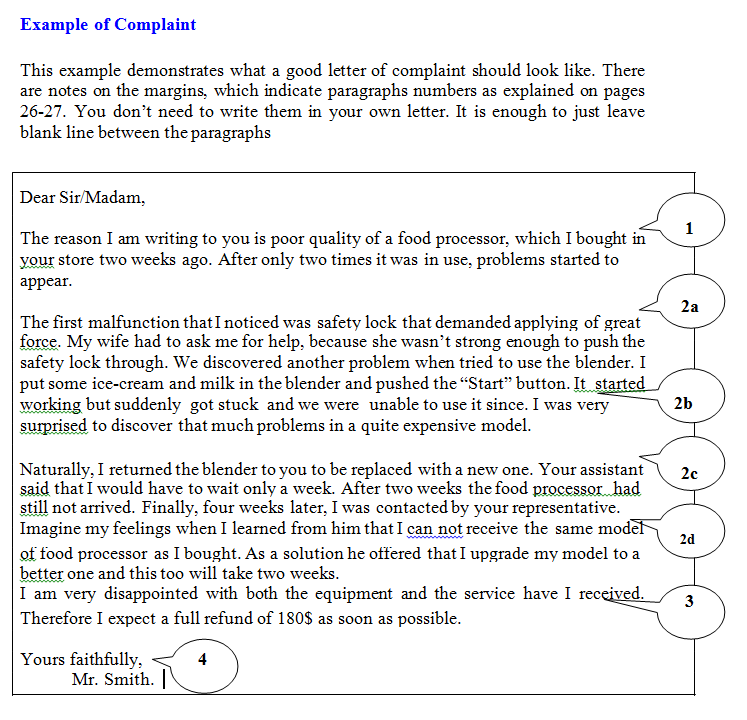
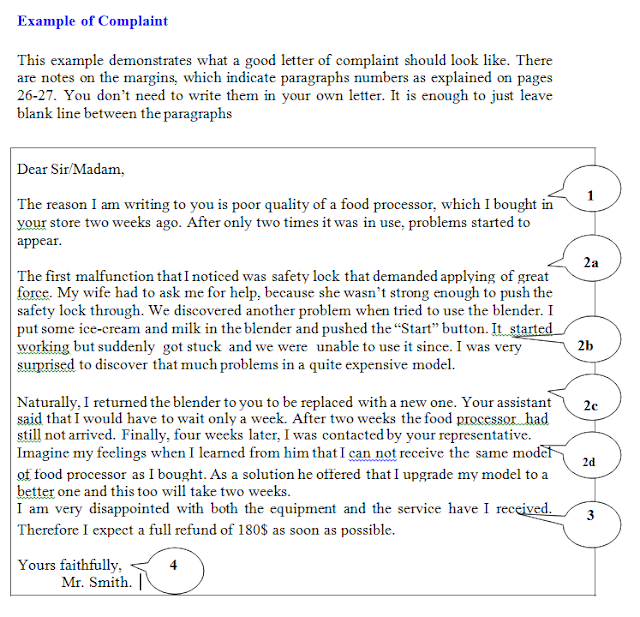
For Paragraph 1
·
“I am writing to complain about…”
·
“I am writing in regard to…”
·
“The reason
I am writing to you is (a problem with…)”
·
“I am writing to express my concern about/dissatisfaction with…”
·
“I would like to bring the matter of … to your attention.”
·
“I would like to draw your attention to …”
For paragraph 2
·
“I was supposed to receive … Unfortunately, that never happened.”
·
“You can imagine how unhappy I was to discover …”
·
“I regret to inform
you that your service was below my expectations.”
·
“When I tried
to contact you by phone, no one could offer me any sensible answer.”
·
“I contacted
your representative in …. Unfortunately, he denied me the service that I requested.”
For paragraph 3
·
“The ideal solution would be … “
·
“I hope you can settle this matter by …(doing something)”
·
“I insist on
getting a refund of …”
·
“Please look into this matter as soon as possible.”
·
“I believe
this matter deserves your urgent attention.”
Request
of information letter
This
is a letter you write to ask a person for information. For example, you may need to receive the trains’ timetable, or
list of books on certain topic from a library or an itinerary for a trip you have booked to Africa.
There are 3
paragraphs in this type of letter. They should look like this:
1. Start with “Dear Sir/Madam,“ (or write person’s
name if it was given in task instructions)
Explain shortly (in one or two sentences) what kind
of information you are interested in.
“I am writing to ask for information about
membership in the Shape sports club.”
2. Explain in more details who you are, exactly what information you need, why, when
and in what form do you need it – a letter,
a fax, an e-mail, a phone-call,
etc. This should be the biggest paragraph of the whole letter.
3. Write formal ending
for the letter,
your name and sign.
“I look forward to hearing
from you.”
If you know the name of
person you are writing to, sign
“Yours sincerely,
Mr. Smith”
If you don’t know the name of person
you are writing
to, sign “Yours faithfully,
Mr. Smith”
Example of Request letter
This
example demonstrates what a good letter of request for information should
look like. There are notes on the margins,
which indicate paragraphs numbers as explained on pages 30. You don’t need to
write them in your own letter. It is enough to just leave blank
line between the
paragraphs
Job application letter
This is a letter you write to apply for
a certain position that is vacant. In the real life you would attach your
resume to it. Of course, you don’t have to do it for IELTS, writing the letter
is enough.
There are 4
paragraphs in this type of letter. They should look like this:
1. Start with “Dear Sir/Madam,“ (or write person’s
name if it was given in task instructions)
Write
what position are you applying to, and where it was advertised.
“I would
like to apply for the position of secretary advertised in ‘Herald Tribune’ of
April 15th 2005.”
2. Write about your skills, diplomas
and experience.
“I am a Software Engineer
with more then ten years of experience in …” “I graduated in Some Study Course from Famous University, 1996”
“At present I am employed
as a … by company
…” “I am familiar with…”
“My
skills include working with …, performing …, managing…”
“In course of my present job I have been
responsible for the planning and organization of …”
“I am used to working at a fast pace
to meet deadlines”.
As in previous types of letters, this paragraph
should be the “fattest” in the whole letter.
3. Explain, why you are interested in this job,
express your motivation to contribute. Ask to schedule an interview as soon as possible.
“I
would like to apply my skills in your company.”
“I
believe the position you offer will give me opportunity to...”
“If you find my skills and experience suitable,
please contact me to schedule an interview.”
“I am looking forward to discussing
my credentials with you personally.”
4. Thank the person.
“Thank
you for your time and consideration.”
If you know the name of person
you are writing to, sign “Yours sincerely,
Mr. Smith”
If you don’t know the name of person you are writing
to, sign “Yours faithfully,
Mr. Smith”
Example of Job Application
Personal Letter
Personal letter is usually written to a friend or a
relative. It doesn’t have many strict rules. I have a couple of suggestions
that will make your life easier:
1. Start with something
like “Dear Linda,”
or “My dearest Charlie,”
Then apologize that you forgot
to write.
“I am sorry I haven’t written for so
long.”
Next,
write the purpose of your letter
“I
am writing to thank/tell/ask/apologize/wish…”
2. Start writing on a topic from paragraph 1. Once again,
this paragraph must be
the biggest one. If possible, try to write
2 paragraphs (2a and 2b).
3. Sign : “With
best wishes, Kathy” “Yours, Louse”
“With love and many thanks from me, Diana”
Example of
Personal Letter
Formal Business letter
Any letter other than Complaint,
Request, Job application, or Personal is a Business letter. It could be an
explanation you write to a library about the books that were never returned, or
a letter to Car Rental Company, describing the road accident you were involved
in.
There are 4
paragraphs in this type of letter. They should look like this:
1. Start with “Dear Sir/Madam,“ (or write person’s
name if it was given in task instructions)
Explain shortly (in one or two sentences) who you
are and/or what are you writing about.
“I am writing in regard to books I borrowed from the
library on March 15, 2005 and never returned”.
2. Explain in more details the purpose of your letter.
Consider the idea that task instructions give you, write according to it. Make
up interesting details in addition to the original idea.
This should be the biggest
paragraph of the whole
letter.
3. Say what kind of answer you expect or what
suggestions do you have for the situation. It is also a good place
to apologize, if applicable.
4. Write formal ending
for the letter,
your name and sign.
“I look forward to hearing
from you.”
If you know the
name of person you are writing to, sign
“Yours sincerely,
Mr. Smith”
If you don’t know the name of person
you are writing to, sign “Yours faithfully,
Mr. Smith”
Example of Formal Business letter
Do it right!
Now,
when you know what a letter should look like, it’s time you learn the technique how to write it fast.
It works for absolutely any kind of letter. After writing a couple
of letters you will realize,
that writing down a 150 words alone takes you 15 minutes, plus you have to think of a story
to tell in your letter,
to make it interesting.
So this is how you do it:
1. When you get the writing assignment, first look and
understand what kind of letter do you need to write: complaint/request,
business, job application or personal.
2. Read the assignment and write down on the draft paper 3 first
things that come to your mind. Those ideas must refer
to the topic directly. If there are a number of things you need to write about,
refer to every one of them. Make
things up, be creative, it doesn’t have to be the absolute
truth. Stop right there,
no more thinking!
3. Start writing. First paragraph requires no thinking
– write 1-2 sentences that explain the topic
of your letter.
4. Remember the 3 things you made up? Use them while
you are writing paragraph two. Make it the largest paragraph
because it is your only chance to get
150 words in the letter.
5. When paragraph two is done, paragraph three and
four (if applicable) are a piece of cake,
because they generally
are based on paragraph two.
6. After you have finished writing, read the letter
once again and check for spelling and punctuation errors.
Practice, practice, practice!
I believe that practicing in writing is
a must. Use the following topics to practice in writing letters as much as you
can. They will also help you understand better how to classify the letter tasks – to know what kind of letter you need to
write.
Complaint letters tasks
Topic 1
You should
spend no more than 20 minutes on this task and write at least 150 words.
You have
bought a mobile phone in a tax-free shop just a few days ago, and it doesn’t
work properly.
Task: Write
a letter to the manager to complain about it and ask him to solve the problem.
You do not
need to write your address.
Begin your
letter as follows: Dear Sir/Madam,
Topic 2
You should
spend no more than 20 minutes on this task and write at least 150 words.
You rented a car from Car
Rental Company. The air conditioner has stopped working. You phoned the company
a week ago but it has still not been repaired.
Write a letter to the
company. In your letter
introduce yourself
explain the situation
say what action you would like the company to take
You do not
need to write your address.
Begin your
letter as follows: Dear Sir/Madam,
Request
of Information letter tasks
Topic 1
You should
spend no more than 20 minutes on this task and write at least 150 words.
You are a student who wants
to apply to Green Pines College. You are experiencing financial problems at the
moment.
Task:
Write a letter to the Principal of the College, explaining your situation and
ask for information on scholarships or other means of financial help available.
You do not
need to write your address.
Begin your
letter as follows: Dear Sir/Madam,
Topic 2
You should
spend no more than 20 minutes on this task and write at least 150 words.
You would like to participate
in a work-related seminar in
another country.
Task:
Write a letter to the person in charge of the seminar and ask for detailed
information regarding the dates, program, accommodations and cost.
You do not
need to write your address.
Begin your
letter as follows: Dear Sir/Madam,
Job
Application letter task
Topic 1
You should
spend no more than 20 minutes on this task and write at least 150 words.
You want to apply for the
following job. Write a letter to Mrs. Keller describing your previous
experience and explaining why you would be suitable for the job.
Advertisement:
Housekeeper required for private home. Experience is necessary. Contact Mrs. D.
Keller.
You do not
need to write your address.
Begin your
letter as follows: Dear Sir/Madam,
Personal letters tasks
Topic 1
You should
spend no more than 20 minutes on this task and write at least 150 words.
You stayed at your friends’
house when you participated in a business seminar in Australia. You left a file
with important documents in your room.
Task: Write
a letter to your friend, describing the file and ask him/her to return it to
you by post.
You do not
need to write your address.
Begin your
letter as follows: Dear Sir/Madam,
Topic 2
You should
spend no more than 20 minutes on this task and write at least 150 words.
You migrated to another country.
Task: Write
a letter to your friend to describe your present life and tell him/her why you
choose this country.
You do not
need to write your address.
Begin your letter as follows: Dear Sir/Madam,
Business
Letter tasks
Topic 1
You should
spend no more than 20 minutes on this task and write at least 150 words.
You
successfully passed a job interview. You are expected to start on November 15,
but you will not be available on that date.
Task: Write
a letter to your new boss, explaining your situation, expressing your concern and suggesting solution.
You do not
need to write your address.
Begin your
letter as follows: Dear Sir/Madam,
Topic 2
You should
spend no more than 20 minutes on this task and write at least 150 words.
You are a gift shop keeper.
Task:
Write a letter to your supplier, to let him know that you won’t need the
merchandise you have ordered. Explain your situation and suggest solution.
You do not
need to write your address.
Begin your
letter as follows: Dear Sir/Madam,
Topic 3
You should
spend no more than 20 minutes on this task and write at least 150 words.
You are a secretary, planning a corporate event.
Task:
Write a letter to Entertainment Company explaining what kind of party you would
like it to be, indicate date and time of event and your special requests.
You do not
need to write your address.
Begin your
letter as follows: Dear Sir/Madam,